
Guide
Weighing, dilutions and strength
Every regulatory answer on this site is a percentage of something. Get the weighing wrong and every one of them is wrong too, quietly, in a way no compliance check can catch.
Checked against the sources named at the foot of this page on 12 August 2026.
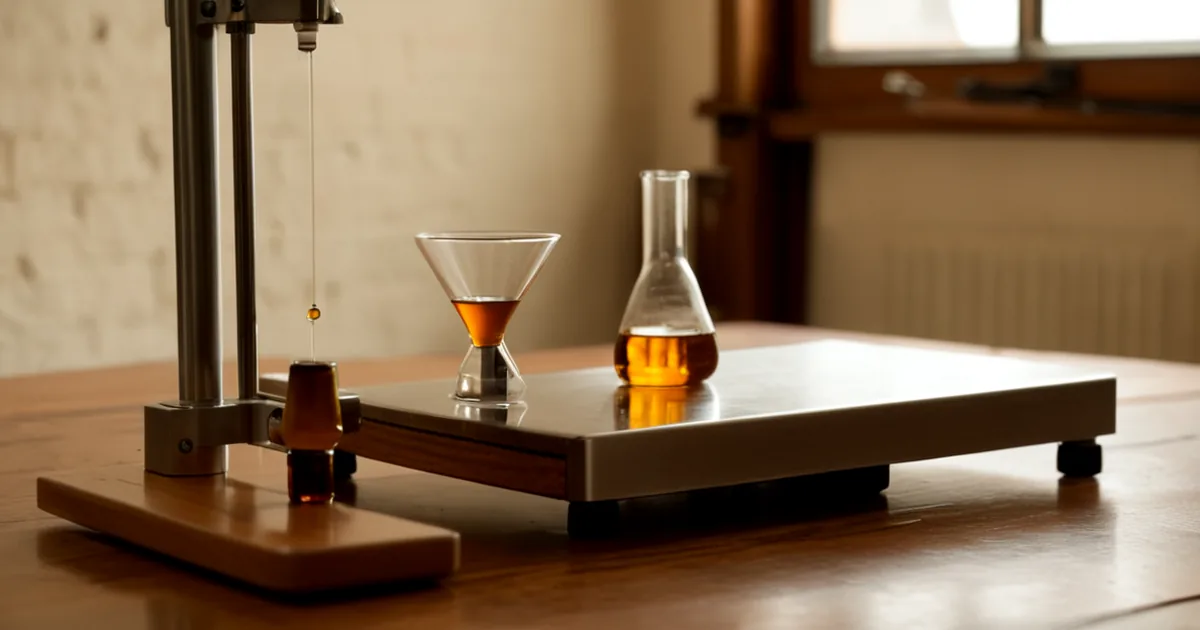
A drop is not a unit
Almost everyone starts in drops, because the materials arrive in bottles with droppers and counting is easier than weighing. It works until the moment you want to make the same thing twice.
The size of a drop is not a property of the material alone. It depends on the viscosity and surface tension of the liquid, on the bore of the dropper, on how the bulb is squeezed and at what angle, on how full the pipette is, and on the temperature of the room. A thick resinoid gives a heavier drop than ethanol from the same dropper. Change the dropper and everything changes.
That means a formula in drops is not a formula. It is a note about one afternoon. It cannot be scaled, cannot be handed to anybody else, cannot be reproduced by you in a year, and cannot be assessed against any rule, because every rule in this trade is written as a percentage by weight.
Grams are reproducible by anyone, on any balance, in any country, for as long as the record survives. That is the whole argument, and it is why every professional formula you will ever see is written in weight or in parts by weight.
Readability is not accuracy, and minimum weight is the number nobody quotes
Balances are sold on readability: the smallest increment the display can show. A balance described as reading to 0.001 g shows you three decimal places. That is not the same as being accurate to 0.001 g, and the difference is where a lot of quiet error lives.
The figure that actually matters is the minimum weight, which the manufacturer states in the specification and almost nobody reads. It is the smallest load the instrument can weigh while staying inside its own stated accuracy. It is often ten or twenty times the readability. Below it the display still shows digits, and those digits are inside the instrument's error rather than being a measurement.
So a balance reading to 0.001 g with a minimum weight of 0.02 g is telling the truth about anything from 0.02 g upward, and telling you a story below that. Weighing 0.004 g of a powerful aromachemical on it produces a number that looks precise and means very little.
What the display shows, and what it can be trusted at
Readability
0.001 g
The smallest increment the display can show. What the balance is sold on.
Minimum weight
0.02 g
The smallest load it stays inside its own stated accuracy at. In the specification, rarely on the box.
so weighing 0.004 g of a powerful material
The way around it is not a better balance. It is a dilution: weigh a larger, honest amount of a weaker solution instead of a tiny amount of the neat material. The two figures here are typical of a three-decimal bench balance; read your own instrument's specification.
The way around that is not a better balance. It is a dilution: weigh a larger, honest amount of a weaker solution instead of a tiny amount of the neat material. That is the real reason perfumers keep dilutions, and it is a measurement decision before it is a convenience.
Two habits worth having from the start. Let a balance warm up and settle before trusting it, and use the draft shield if it has one, because at three decimal places the room's air currents are a real signal. And put a known check weight on it now and then; a balance that has drifted gives wrong answers with total confidence.
Making a dilution, and labeling it so it survives
A 10 percent dilution means 10 parts material in 100 parts of the finished solution, by weight. Weigh 1 g of the material, add 9 g of solvent, and you have 10 g at 10 percent weight for weight.
Making a 10 percent dilution
weighed, not measured by volume
1 g into 10 g of solvent would be 9.09 percent, not 10.
What 2 g of that dilution puts in your formula
only a tenth of it is material
Count the whole 2 g as material and every limit reads ten times over. Ignore the solvent entirely and the mass of the blend is wrong instead.
Two mistakes to avoid at this step. Do not add 10 g of solvent to 1 g of material and call it 10 percent, because that is 1 part in 11, which is 9.09 percent. And do not make it by volume, because a milliliter of one material and a milliliter of another do not weigh the same. Weight for weight is the convention, and mixing the two conventions across a formula is how a blend drifts without anyone being able to say where.
Then label the bottle properly. A dilution bottle should carry the material, the solvent, the percentage, the basis, and the date it was made. A bottle marked only ten percent is nearly worthless a year later: ten percent of what, in what, and is the solvent ethanol, dipropylene glycol or triethyl citrate? Those three behave differently in a blend and one of them is not suitable for every product.
Record the lot of the material you diluted, too. When a supplier tells you two years from now that a particular lot was off specification, the question you will need to answer is which of your dilutions and which of your batches it went into.
Dilutions of dilutions, and where the error compounds
Making a 1 percent solution by diluting your 10 percent tenfold is normal practice and perfectly sound, as long as everyone remembers what the final number refers to. The 1 percent is 1 percent of the original material, not 1 percent of the 10 percent solution.
The risk is not conceptual, it is arithmetic drift. Each step carries its own weighing error, and errors compound rather than cancel. A chain three deep, each step a little generous, can put the real concentration meaningfully away from the label on the bottle, and nothing downstream will ever notice, because everything downstream trusts the label.
This matters for compliance and not just for smell. When you weigh 2 g of a 10 percent solution into a formula, only 0.2 g of it is material and 1.8 g is solvent. An assessment that counts the whole 2 g as material reports a formula far over the limits it is actually at. One that ignores the solvent entirely gets the total mass of the blend wrong. Both are common, and both come from a formula that recorded what was weighed without recording what it was.
Density, and why you should never invent one
Density is what lets you convert between volume and weight, and you need it whenever a figure arrives in milliliters: a supplier quoting by volume, a bottle filled to a nominal content, an old formula written in parts by volume.
Published densities for naturals are typical values across a range of origins, distillations and seasons. They are a reasonable starting point and they are not your bottle. If a number matters, measure it: weigh a known volume of the actual material at a known temperature and divide. Your own measurement of your own material outranks any published figure, every time.
What you must not do is guess one to make a calculation complete. A guessed density silently propagates into the strength, into the IFRA position, and into the allergen figures, and it leaves no trace saying it was a guess. It is far better for a number to be missing and known to be missing than present and quietly invented.
What the strength on the bottle actually means
A finished perfume is a fragrance concentrate diluted in something, usually ethanol with a little water. The strength is the percentage of concentrate in the finished liquid: an eau de parfum at 20 percent is one fifth concentrate and four fifths everything else.
The familiar names are conventions and not definitions. Nothing in law fixes where an eau de toilette ends and an eau de parfum begins. The rough bands in common use run something like this, and houses disagree at every boundary:
| Name | Concentrate, roughly |
|---|---|
| Extrait, or parfum | 20 to 30 percent |
| Eau de parfum | 15 to 20 percent |
| Eau de toilette | 5 to 15 percent |
| Eau de cologne | 2 to 5 percent |
The strength names, as the overlapping bands they are
Customary usage on a scale of 0 to 30 percent concentrate, not a legal definition. Nothing fixes where one band ends and the next begins, so the name on your bottle is a marketing decision and the number behind it is not.
Because the bands overlap and nothing enforces them, the name on your bottle is a marketing decision. The number behind it is not. Every compliance answer you will ever give is computed from the actual percentage, so that is the figure to record, and to record as a percentage of the finished product rather than as a name.
Why all of this decides your compliance answers
Here is the chain, and every link in it is a weighing.
A material is a percentage of your concentrate. Your concentrate is a percentage of the finished product. An IFRA limit and an allergen threshold are both percentages of the finished product. So the position of any one material against any one rule is the product of the whole chain, and if a dilution in the middle of it was labeled 10 percent when it was really 9, or if a natural's composition was taken on trust, the final figure is wrong by that much and nothing in the calculation can tell.
This is the reason a compliance check is only ever as good as the bench discipline underneath it. Software can do the arithmetic perfectly and still produce a confident wrong answer, if what it was told about the bench was wrong. The most valuable habits are unglamorous: weigh everything, label dilutions completely, record lots, measure the densities you rely on, and write down what actually came off the balance rather than what the formula said should.
Record what happened, not what was supposed to happen
A formula is an intention. A batch record is a fact. They are not the same document and the difference is the entire value of the second one.
If the formula said 4.00 g and 4.06 g came off the balance, 4.06 is what went in the bottle and 4.06 is what the record should say. Writing the intended figure back into the record makes the paperwork tidy and makes it fiction, and it is the reason a batch that behaves differently can never be explained afterward.
The same applies to the strength. A batch topped up slightly is a batch at a different concentration, which means a different position against every threshold. Recorded honestly, that is a fact you can act on. Rounded back to the plan, it is a discrepancy waiting years to be found.
How Orris Bench handles this
Orris Bench works in grams throughout, and treats a dilution as what it is: a material at a stated strength in a stated solvent, made on a date from a known lot. When a dilution goes into a formula, only the material part of it counts as material, and the solvent is accounted for rather than ignored or double counted.
Weighing is done against the sheet, line by line, with a connected balance, so what is recorded is what actually came off the balance rather than what was planned, and the strength that truly resulted is what the documents are computed from. Where a density is not known it stays not known and says so, rather than being filled in with a plausible figure that would travel silently into a regulatory answer.
The batch record is the fact, and the batch number ties it to the lot of every material that went into it. Everything downstream, the IFRA position, the allergen declaration, the label, is computed from that record rather than from the intention that preceded it.
A note on this page
Unlike the other guides on this site, this one describes bench practice rather than a regulation, so there is no official text behind it to cite. It is how the work is done and why, written from doing it. The strength bands are customary usage and no more than that. Where it touches the rules, the IFRA and allergen guides on this site carry the sources.
Common questions
Why do perfumers weigh in grams instead of counting drops?
Because a drop is not a unit. Its size depends on the liquid's viscosity and surface tension, on the pipette bore, on how hard the bulb is squeezed and on the temperature of the room. The same dropper gives noticeably different drops for ethanol and for a resinoid. Grams are reproducible by anyone, on any balance, years later, which is exactly what a formula and a batch record have to be.
What balance do I need for perfumery?
Readability matters more than capacity. A balance reading to 0.01 g is workable for batches of 20 g and up; 0.001 g opens up small trials and accurate work with materials used at a fraction of a percent. Check the minimum weight the manufacturer states, not just the readability: below it the reading is inside the instrument's own error and means very little.
How do I make a 10 percent dilution?
By weight, not by volume. Weigh 1 g of material and 9 g of solvent, giving 10 g at 10 percent weight for weight. Doing it by volume gives a different answer for anything whose density is not 1, and most aroma materials are not. Label the bottle with the material, the solvent, the percentage, the basis and the date, because a bottle marked only 10 percent is worth very little a year later.
What does 20 percent eau de parfum actually mean?
That the finished liquid is 20 percent fragrance concentrate and the rest is mostly ethanol and water. The terms extrait, eau de parfum, eau de toilette and eau de cologne describe a rough band of strength, not a defined one; no law fixes their boundaries, and two houses can label the same 15 percent liquid differently. The number that matters for compliance is the actual percentage, and what it is a percentage of.