
Guide
Shelf life and storage
Citrus is tired in two years and sandalwood improves for eight, and nothing about how they smell tells you that. It is the chemistry that decides, and an oil that has gone over is not merely disappointing.
Checked against the sources named at the foot of this page on 13 August 2026.
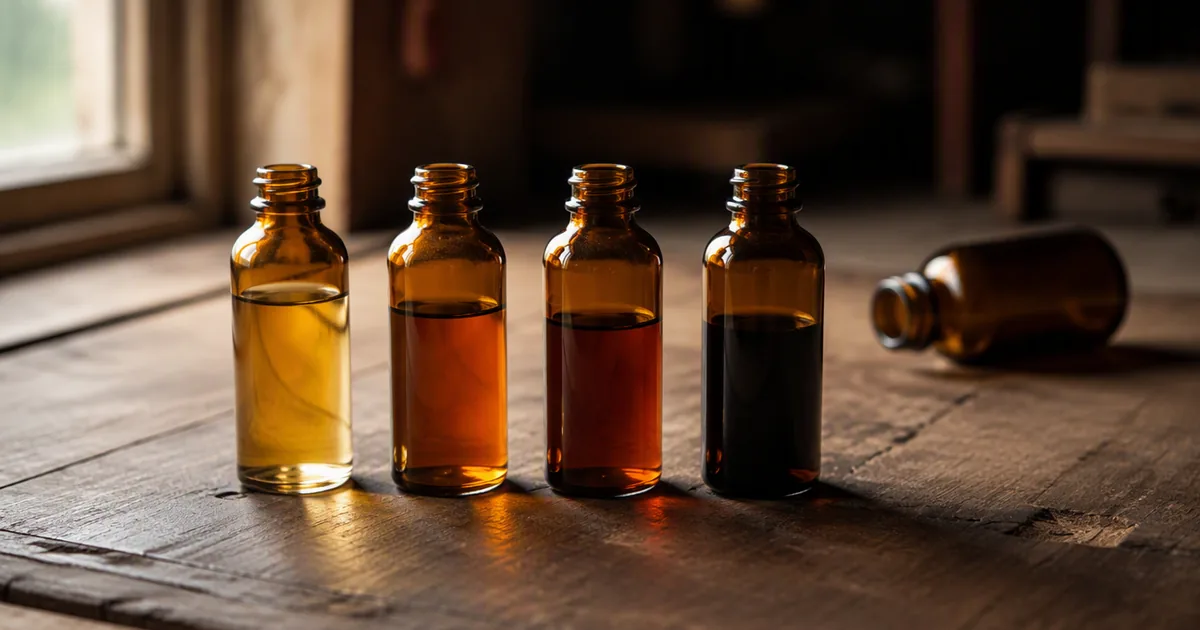
The smell tells you nothing. The chemistry decides.
Ask how long an aroma material keeps and the useful answer is not about the plant it came from or the note it plays in a formula. It is about which class of molecule dominates it, because that is what decides how fast it reacts with the oxygen in the bottle.
This is why a rule of thumb by odor family is worthless. A woody material can be a sesquiterpenol that keeps for the better part of a decade, or a synthetic aldehyde that is tired inside a year. They sit next to each other on the shelf and in the pyramid, and they have nothing in common that matters here.
How long each class actually lasts
Useful life in cool storage, by what the material is made of
Cool storage. The longest-lived class lasts four times the shortest, and the sesquiterpenes at the top improve with age rather than declining. Halve every figure for a bottle kept at room temperature.
One class is not on the chart because it does not belong on it. A solvent in a closed bottle does not autoxidize the way a terpene does, and no published limit applies; the sensible interval there is a housekeeping one, which is to smell it before it carries another dilution. And where a material's chemistry is not established, no figure is derived at all, because a plausible guess about how long something stays safe is worse than an admission that nobody knows.
Cool storage doubles all of it, and this has been measured
The working rule is that room-temperature life is half of cool-storage life, and that warm climates are worse still. It is not a hedge; the mechanism has been measured directly.
What a year does to a lemon oil
25 degrees C, cap off three minutes a day
67.1% to 30.7%
limonene remaining after twelve months
5 degrees C, opened monthly
almost unchanged
over the same twelve months
More than half the limonene gone in a year, from temperature and air alone. Two things are doing the damage and both are within your control: how warm the bottle is kept, and how often it is opened.
The practical consequences follow directly. Keep what you can cool and dark. Decant into a smaller bottle as one empties, so the headspace of air above the liquid stays small. Close bottles properly and promptly rather than leaving a row of them open through a session. Buy the fast-oxidizing materials in quantities you will actually use inside their life, which for citrus means small and often rather than economically large.
An oxidized material is a safety question
This is the part that turns storage from housekeeping into compliance. The oxidation products of terpenes are considerably more sensitizing than the terpenes themselves. An oil that has gone over is not simply flat and disappointing; it is more likely to cause a reaction than the same oil was when it arrived.
That is why several IFRA Standards attach a specification to a material rather than only a concentration limit, and why a peroxide value appears in them at all. A specification is a statement about the bottle on your shelf, not about the formula on your screen, so a material can be comfortably inside its restriction and still fail its Standard because it has aged. It is the one kind of non-compliance that arrives without anybody changing anything.
Fixed oils fail differently and are worth naming separately: they go rancid rather than losing their terpenes, and the test that settles it is the peroxide value, which the European Pharmacopoeia holds to not more than 10 milliequivalents of oxygen per kilogram for vegetable fatty oils.
Period after opening, which is a different question
Everything above is about your raw materials on your shelf. The date on the carton is about the finished product in somebody else's hands, and the two are not the same question.
The EU Cosmetics Regulation requires a date of minimum durability, unless the product keeps for more than thirty months, in which case it carries a period after opening instead: the open jar symbol with a number and the letter M. That is a statement that the product remains safe for that many months once the customer has opened it, and like every other statement on a label it has to be one you can support.
What supports it is stability work on the finished product rather than arithmetic on your materials, and it is one of the things a safety assessor will ask about. A perfume at a high alcohol content is generally a stable thing; an oil-based or water-containing product is a different proposition, and preservation becomes a question the moment water is present.
What to write down
The date a bottle arrived and the date it was first opened, because the second is what the clock actually runs from. The lot, so a supplier telling you two years from now that a lot was off specification is a question you can answer. And where a material went: which dilutions were made from it, and which batches those dilutions reached.
None of that is interesting until the day it is the only thing that matters, which is the day somebody asks about one bottle that left your bench three years ago.
How Orris Bench handles this
A material carries its chemistry class as a fact of its own, kept deliberately separate from its odor family, and the shelf life is derived from that: the cool figure, and half of it for a bottle kept at room temperature. Where the class has not been established, no shelf life is derived and none is shown, because an invented date on a safety-relevant question is worse than a blank one.
Lots carry their own dates, so the clock runs from the bottle rather than from the material in the abstract, and a dilution knows the lot it was made from. That is the same chain the batch record uses, followed in the other direction: from a bottle back to what went into it, or from a lot forward to everywhere it ended up.
Sources
The figures by chemistry class are those the application uses, each taken from published guidance: Robert Tisserand on the citrus, conifer and lemongrass band and on the general two to three year figure, together with his instruction to halve it for oils that are not refrigerated; Aromatics International (Karen Williams, 2020) for the class-by-class ranges. The lemon oil measurement is Sawamura and others, International Journal of Aromatherapy, 2004. The peroxide limit for vegetable fatty oils is the European Pharmacopoeia general monograph. The period after opening requirement is Article 19 of Regulation (EC) No 1223/2009. This page is written for people who make fragrances and it is not legal advice; the stability of your own finished product is a question for the person who assesses it.
Common questions
How long do essential oils last?
It depends on the chemistry rather than on the plant. Kept cool, monoterpene-rich materials such as citrus peel and the conifers get about two years; oxide-rich and alcohol-rich materials such as eucalyptus and lavender about three; phenol-rich and ester-rich about four; ketone-rich and the absolutes and resinoids about five; and sesquiterpene-rich materials such as sandalwood, vetiver and patchouli eight or more, improving rather than declining. At room temperature, halve all of it.
Does refrigerating aroma materials actually help?
Substantially, and it has been measured. In one study the limonene content of a lemon oil fell from 67.1 percent to 30.7 percent over twelve months at 25 degrees Celsius with the cap off for three minutes a day, while an equivalent sample at 5 degrees opened monthly barely moved. The working rule that follows is that room-temperature life is about half of cool-storage life, and warm climates are worse.
Is an oxidized oil dangerous or just disappointing?
It is a safety question, not only a quality one. Oxidation products of terpenes are markedly more sensitizing than the terpenes themselves, which is why several IFRA Standards attach a peroxide specification to a material rather than only a concentration limit. A material can be comfortably under its restriction and still fail its specification because the bottle has aged.
What is the period after opening symbol?
The open jar with a number and the letter M, which says how many months the product remains safe once it has been opened. Under the EU Cosmetics Regulation a product with a minimum durability of more than thirty months carries this instead of a best-before date. It is a statement about the finished product in a customer's hands, which is a different question from how long your raw materials keep on your shelf.