
Guide
Candles, diffusers and room sprays
The most common mistake in home fragrance is assuming that because a perfume needs a responsible person and a product file, a candle needs one too. It does not. It needs something else entirely.
Checked against the sources named at the foot of this page on 13 August 2026.
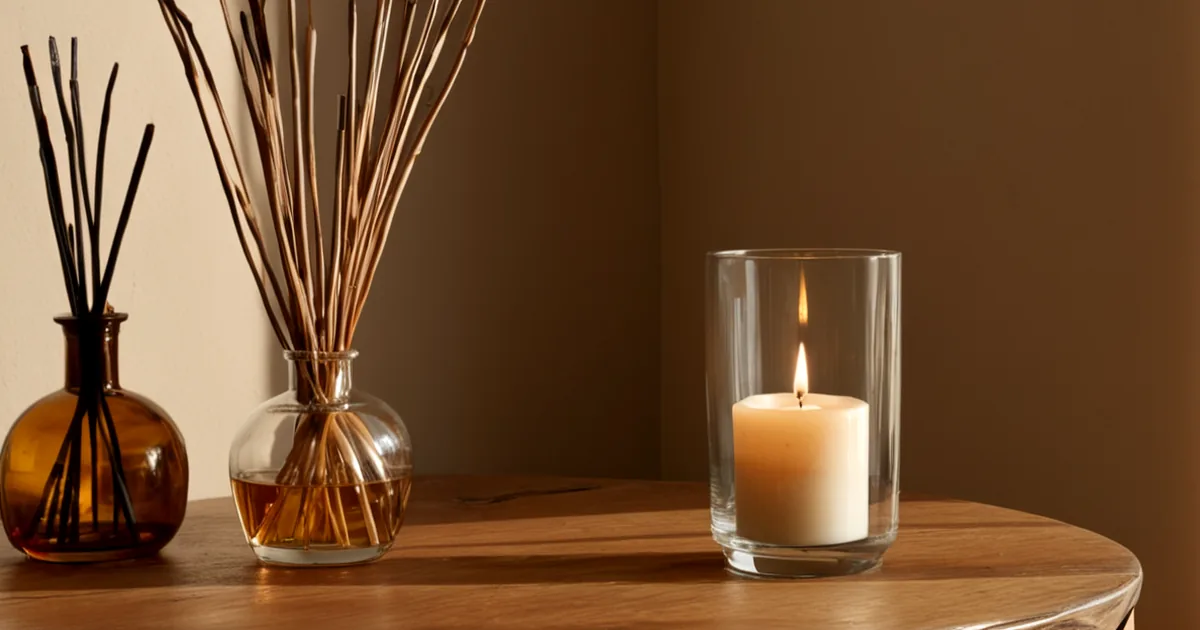
None of these is a cosmetic
A cosmetic is something applied to the external parts of the body. A candle is not, a reed diffuser is not, and a room spray aimed at a room rather than at a person is not. So the whole apparatus most fragrance guidance describes falls away: no responsible person, no Product Information File, no Cosmetic Product Safety Report, no portal notification.
That sounds like good news and is only half of it. The cosmetics regime is also the one that would have had a qualified assessor look at your product and tell you it was safe. Without it, nobody does that for you, and a different set of obligations applies that catches more home fragrance than most makers expect.
The same fragrance oil, three different regimes
In a perfume
Cosmetics law
Responsible person, product file, safety report, portal notification, INCI ingredient list with allergens named.
In a candle or diffuser
Chemicals and product safety law
CLP classification and label if the mixture is hazardous, general product safety, poison center notification, and the candle standards where they apply.
Sold by the kilo to another maker
Chemicals law, in full
All of the above, plus a safety data sheet, because you are now a supplier of a mixture to a downstream user.
One liquid, three legal identities decided entirely by what the customer buys. Most home fragrance businesses end up in at least two of these columns.
CLP is the one that catches people
If the mixture in your product is classified as hazardous, it needs a CLP label. That means the hazard pictograms, the signal word, the hazard and precautionary statements, the substances responsible for the classification named on the label, the nominal quantity, and your name and address as supplier.
Fragrance materials commonly carry classifications for skin sensitization and for aquatic toxicity, which is why this reaches so much home fragrance. Whether your product is caught depends on which materials are in it and at what dose, and that is a calculation on your actual formula rather than a rule of thumb: the same oil at 6 percent in a candle and at 20 percent in a diffuser base can land on opposite sides of a threshold.
Your fragrance supplier should give you the classification data for the oil, and for a properly documented oil that is the starting point rather than the answer, because the classification of your finished product depends on your dilution of it.
Two more pieces attach to the same obligation. A hazardous mixture placed on the EU market needs to be notified to poison centers, and the label carries a unique formula identifier tying it to that notification. Great Britain did not adopt that system and has no equivalent.
Which IFRA category you are in, and why it matters so much
Home fragrance sits at the top of the IFRA category range, and the differences between the categories up there are large. Getting this wrong in either direction is expensive: assume category 12 for a diffuser and you may be well over a limit, assume category 10A for a candle and you have reformulated for nothing.
Where home fragrance falls
A diffuser is handled, so it is treated as a product with skin contact. A candle is not. That single distinction moves some limits by a factor of many, and it is why an oil sold as suitable for candles is not automatically suitable for a diffuser.
One consequence worth knowing: categories 11A and 12 carry no phototoxicity limits at all, because 11A is contact without sunlight and 12 is not skin contact. So a citrus oil that looks alarmingly restricted for a body product may be entirely unrestricted in a candle, and the restriction was never about how much of it is safe in the abstract. It was about sunlight.
Candles have their own safety standards
Separately from anything about fragrance, a candle is a product that burns in somebody's house, and there is a set of European standards covering exactly that. Following them is how you demonstrate the product is safe, and Great Britain uses the same standards through its own designations.
| Standard | What it covers |
|---|---|
| EN 15493 | Fire safety of indoor candles: how it burns, whether the flame stays where it should, secondary ignition. |
| EN 15426 | Sooting behavior. How much soot a candle may produce. |
| EN 15494 | The product safety label: the warnings a candle must carry about how to burn it safely, and how they must be shown. |
Burn testing is the part small makers skip and should not. A change of vessel, of wick, of wax or of fragrance load is a change to how the candle burns, and a candle that tunnels, smokes, or throws a flame is a safety matter rather than a quality complaint. The CLP label and the candle safety label can be combined on one label as long as both are satisfied.
None of these standards applies to a reed diffuser, which does not burn. A diffuser is under general product safety and CLP instead, and its own risk is different: it is an open container of a flammable, sensitizing liquid at a height a child or an animal can reach, and it damages surfaces if it is knocked over.
General product safety applies to all of it
Underneath everything else there is a general obligation that consumer products placed on the market must be safe, and it applies whether or not any specific standard names your product. It also carries the ordinary duties around it: identifying the product and yourself, keeping traceability so a problem can be tracked, and acting when something goes wrong.
The practical version of that is unglamorous and familiar from every other page on this site. Know what went into each batch, know which lot of which material it came from, and be able to say so a year later. A recall you can target to one batch is an inconvenience. A recall you cannot is the whole product.
Do allergens have to be declared?
Not through the cosmetics route, because these are not cosmetics and Article 19 does not reach them. The requirement that does reach them comes from CLP, where a mixture containing a sensitizing substance above the relevant limit has to say so on the label even when the mixture is not otherwise classified. That is a different mechanism with different triggers, and it is answered from the same underlying data.
Many home fragrance makers list the common fragrance allergens voluntarily. There is nothing wrong with that, and it is worth being clear with yourself about which parts of your label are required and which are chosen, because the required parts are the ones that must be right.
How Orris Bench handles this
The IFRA assessment is run at the category the product is actually sold in, so a diffuser is assessed as 10A and a candle as 12 rather than both being checked against a fine fragrance limit that was never theirs.
For the products that are mixtures rather than cosmetics, it classifies against CLP and generates the safety data sheet and the label from the same record the formula lives in. The batch record works the same way it does for a perfume: a batch number tying the finished product to the lot of every material in it, which is what makes traceability something you have rather than something you intend.
Sources
The classification and labeling obligations are Regulation (EC) No 1272/2008 (CLP) and, for Great Britain, its retained equivalent. The definition that excludes these products from cosmetics is Article 2 of Regulation (EC) No 1223/2009. The candle standards are EN 15493 on fire safety, EN 15426 on sooting behavior and EN 15494 on product safety labels, adopted in Great Britain under its own designations. The IFRA category assignments are from Table 11 of the IFRA Standards Guidance. This page is written for people who make fragrances and it is not legal advice; whether your particular mixture is classified as hazardous is a question about your formula, and the current texts are the authority.
Common questions
Is a candle a cosmetic?
No. A cosmetic is applied to the external parts of the body, and a candle is not. So there is no responsible person, no Product Information File, no safety report and no cosmetics portal notification. It also means the reassurance a cosmetic safety assessment would have given you is not there, and a different set of obligations applies instead.
Does a candle need a CLP label?
If the mixture is classified as hazardous, yes: pictograms, signal word, hazard and precautionary statements, the substances that drove the classification, and the supplier details. Fragrance materials commonly carry skin sensitization and aquatic hazard classifications, so this catches more home fragrance than makers expect. Whether your particular product is caught depends on what is in it and at what dose.
Which IFRA category is a candle?
Category 12, which covers products with no skin contact and no meaningful exposure. A reed diffuser is category 10A, because it is handled. A room spray or air freshener is 10B. The limits differ a great deal between them, so a fragrance oil sold as suitable for candles is not automatically suitable for a diffuser.